May 27, 2026
Share:
Subscribe now and get our latest blog and video content delivered straight to your inbox.
May 27, 2026

Updated November 2026 by Kyla Pehr, Content Coordinator
TL;DR
The best dryer vent cleaning kit for most homes is a drill-powered rotary system with flexible rods, such as the Gardus LintEater, which Bob Vila's testing ranked best overall. Choose a 30-foot rod kit for long runs, and a simple hand brush only for quick touch-ups near the lint trap.
Key takeaways
- Drill-powered rotary kits clean the full length of the duct; manual brushes only reach the lint trap and vent opening.
- In Bob Vila's testing, the Gardus LintEater ranked best overall, the Holikme 30-Foot Kit had the longest reach, and the Holikme 2-Pack was the budget pick.
- Measure your vent run and count the bends before you buy.
- Screw-together rods must spin clockwise only; the LintEater Pro's button-link rods run forward and reverse.
- Clean the vent at least twice a year, and call a professional for roof exits or damaged ducts.
Lint is highly flammable, and most of it never reaches the lint screen. It settles inside the vent duct, where it narrows airflow and traps heat.
The U.S. Fire Administration (USFA) estimates about 2,900 clothes dryer fires in residential buildings each year, and failure to clean is the leading contributing factor. Across all home fires involving dryers and washers, the National Fire Protection Association reports an average of 13 deaths, 440 injuries and $238 million in property damage per year, with dryers involved in 92% of those fires.
Most of these fires are preventable. Cleaning the lint screen after every load is a good habit, but the vent itself needs a deeper cleaning with the right tool. This guide compares the kits that performed best in Bob Vila's expert testing and shows how to match one to your vent.
What to look for in a dryer vent cleaning kit
- Cleaning power: Drill-powered rotary brushes scrub the duct wall; manual brushes mostly reach the opening.
- Flexibility: Flexible nylon rods follow elbows and turns without kinking or snapping.
- Reach: Total rod length should match or exceed your vent run, or allow cleaning from both ends.
- Brush size: A 4-inch brush matches standard 4-inch dryer ducts for full wall contact.
- Rod connection: Screw-together rods must spin clockwise only; button-link rods can spin both directions.
- Extras: A vacuum adapter, lint trap brush and blockage removal tool save a second purchase.
Best dryer vent cleaning kits of 2026 compared
The Gardus LintEater is the best fit for most homes; the Holikme 30-foot kit wins on reach, and the Holikme 2-pack is the low-cost touch-up tool.
|
Kit |
Best for |
Max reach |
Power |
Rod connection |
Bob Vila award |
|---|---|---|---|---|---|
|
Most homes, vents with bends |
12 ft (extendable) |
Cordless drill |
Screw-connect nylon (clockwise only) |
Best Overall |
|
|
Holikme 30-Foot Kit |
Long runs through attics or crawlspaces |
30 ft |
Cordless drill |
Screw-connect |
Longest Reach |
|
Holikme 2-Pack Flexible Lint Brush |
Quick touch-ups at the lint trap and vent opening |
About 29 in |
Manual |
None |
Best Bang for the Buck |
|
Sealegend 58-Piece Kit |
Buyers who want many accessories in one box |
35 ft |
Drill plus vacuum |
Screw-connect |
Not ranked (Bob Vila's Sealegend pick is a vacuum hose kit) |
Bob Vila's list also includes picks from Vanitek and Smart House; see their full roundup for those.
Our picks, reviewed
1. Gardus LintEater Rotary System: best overall dryer vent cleaning kit
Best for: Most homes, including vents with several turns.
The LintEater earned Best Overall in Bob Vila's testing because it pairs reach with real scrubbing power. A cordless drill spins a self-feeding 4-inch auger brush that breaks lint loose from the duct wall instead of pushing it deeper.
What's in the box:
- Four 3-foot flexible nylon rods (12 feet total)
- Self-feeding 4-inch auger brush
- 2.5-inch lint trap brush
- Vacuum adapter and dryer adapter
- Blockage removal tool
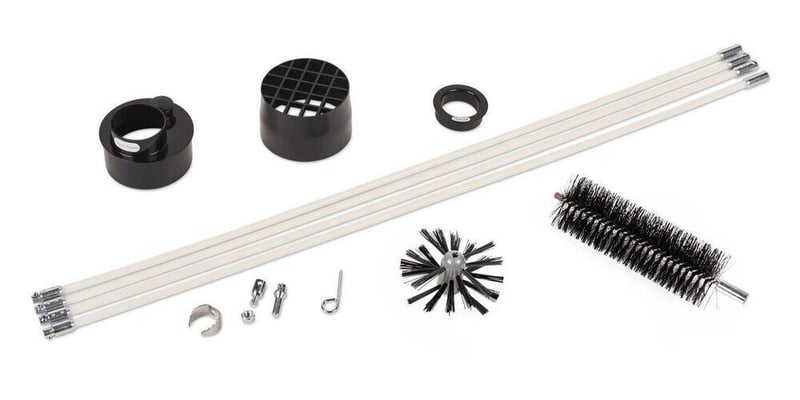
Pros: Flexible rods navigate multiple turns; works from inside or outside the home; extends for longer vents.
Cons: Rods screw together, so the drill must spin clockwise only; requires a drill you already own.
Pick the right LintEater for your vent. Other LintEater variations include:
- LintEater Pro: Button-link rods lock together so you can run the drill forward and reverse without rods coming apart.
- LintEater Jr.: Two 18-inch rods for short runs up to about 6 feet, such as a dryer on an exterior wall.
- 12-foot extension kit: Four more 3-foot rods for vents longer than 12 feet.
Read our hands-on LintEater review for a closer look.
2. Holikme 30-Foot Rod and Brush Kit: best for long vents
Best for: Vents that run through an attic, crawlspace or several walls.
Holikme sells rod-and-brush kits in lengths from 15 to 50 feet; the 30-foot version took Longest Reach in Bob Vila's testing. Screw-connect rods drive a brush with a standard cordless drill.
Pros: Covers long runs in a single pass.
Cons: More setup, clockwise-only rotation, and more care needed through tight bends.
3. Holikme 2-Pack Flexible Lint Brush: best budget pick
Best for: Quick maintenance between deep cleanings.
This manual brush set reaches about 29 inches into the lint trap housing and vent opening to pull out surface lint. It does not connect to a drill and cannot clean the full length of a duct.
Pros: Inexpensive and easy to use.
Cons: Surface cleaning only; not a replacement for a full vent cleaning.
4. Sealegend 58-Piece Kit: most accessories
Best for: Buyers who want one box for the duct, lint trap and surrounding cleanup.
The Sealegend kit bundles 35 feet of screw-thread rods with a vacuum attachment and adapters for various dryer setups. Many accessories are situational, so a rotary system is the stronger choice if cleaning power is the priority.
Which dryer vent cleaning kit is right for you?
The right kit depends on your vent's length, number of bends and exit point, not on price.
- Measure the run: Measure from the back of the dryer to where the vent exits the exterior wall or roof.
- Count the bends: Each elbow adds resistance and makes stiff rods harder to push through.
- Note the exit: A sidewall exit is DIY-friendly; a roof exit often calls for a professional.
- Match the kit to your vent using the table below.
|
Your vent |
Recommended kit |
|---|---|
|
Short run, 6 ft or less |
LintEater Jr. |
|
Up to 12 ft, with or without bends |
LintEater Rotary System or LintEater Pro |
|
12 to 24 ft |
LintEater plus a 12-foot extension kit, or clean from both ends |
|
Over 24 ft, mostly straight |
Holikme 30-Foot Kit or LintEater with extensions |
|
Between deep cleanings |
Holikme 2-Pack brush |
|
Roof exit or crushed duct |
A professional dryer vent technician |
Working with a cramped laundry closet? See our guide to dryer vents for tight spaces.
How often should you clean your dryer vent?
Clean your dryer vent at least twice a year, and more often if you run several loads a day or have a long vent. Dryer fires peak in fall and winter, with January the highest month in USFA data, so late fall is a smart time for a deep cleaning. See our dryer venting and cleaning FAQs for more.
Signs your dryer vent needs cleaning
- Loads take longer than one cycle to dry
- Clothes come out damp or unusually hot
- The dryer or laundry room feels hotter than normal
- A burning or musty smell during a cycle
- The outdoor vent flap barely opens while the dryer runs
- Lint collects around the outdoor vent hood
How to clean a dryer vent with a rotary kit
We have another article explaining how to clean a dryer vent with LintEater, specifically, but to break the process down as simply as possible...
- Unplug the dryer; for a gas dryer, also shut off the gas supply.
- Pull the dryer away from the wall and disconnect the duct.
- Attach the auger brush to one rod and insert it into the vent.
- Spin the drill clockwise at low speed, adding one rod at a time as the brush feeds forward.
- Vacuum loosened lint at the opening with the vacuum adapter.
- Clean the lint trap housing with the lint trap brush.
- Reconnect the duct, push the dryer back and run a short cycle to confirm the outdoor flap opens fully.
Always follow the operator's manual for your kit, including its drill clutch setting.
DIY vs. professional dryer vent cleaning
A rotary kit handles most sidewall vents for less than one professional visit. Call a pro if your vent exits through the roof, the duct is crushed or disconnected inside a wall, or a blockage will not clear. Our dryer vent cleaning cost guide breaks down what a service visit typically costs.
Dryer vent cleaning kit FAQs
What is the best dryer vent cleaning kit?
The Gardus LintEater Rotary System ranked best overall in Bob Vila's testing. Its flexible nylon rods and drill-powered auger brush clean vents up to 12 feet and extend for longer runs.
Do dryer vent cleaning kits really work?
Yes. Drill-powered rotary kits scrub lint from the full length of the duct. Manual brushes only clear the lint trap area and vent opening.
How long of a dryer vent cleaning kit do I need?
Choose a kit at least as long as your vent run. For vents longer than your rods, add extension rods or clean from both the inside and outside ends.
Can I use a drill to clean my dryer vent?
Yes. Most rotary kits are built for a cordless drill. Use low speed and a low clutch setting, and add one rod at a time.
Can I run the drill in reverse?
Only with button-link rods like the LintEater Pro. Screw-together rods can unthread in reverse and leave the brush stuck in the vent.
How often should you clean a dryer vent?
At least twice a year. Clean more often in busy households or if drying times start to stretch.
Can you clean a dryer vent from outside?
Yes. Remove or open the exterior vent hood and feed the brush in from outside. Cleaning from both ends helps on long runs.
Should I hire a professional instead?
A DIY kit handles most sidewall vents. Hire a professional for roof exits, damaged ducts or blockages you cannot clear.