

Mar 27, 2026
Share:
Subscribe now and get our latest blog and video content delivered straight to your inbox.
Mar 27, 2026

TL;DR: Nanette Rota built Praying Nantis Pest Control from $100 in savings after a career in Terminix sales, overcoming gender-based skepticism and outright discrimination in an industry where women make up only about 6-12% of the workforce. Through mentorship and community from Women in Pest & Wildlife Control (WIP&WC), she grew her business rapidly and now mentors other women entering the field, emphasizing sales skills, business fundamentals, and the broader community impact of pest control work.
When Nanette Rota of Praying Nantis Pest Control knocks on your door, there’s no mistaking her.
Pink uniform. Pink glasses. Pink shoes. Even the vacuums and tools follow the theme.
With a pink flyswatter in hand, she might appear to be a South Carolinian fairy godmother, waving it like a wand before delivering a cheerful “ta-da” to wish away whatever creepy crawlies have made their way inside.
Customer interactions have always been Rota’s favorite part of the job. They’ve changed a little since her early days working in sales before eventually becoming a business owner, but her spark hasn’t.
“I make it fun,” Rota said.
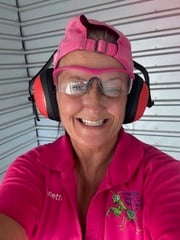
Professionals like Rota are still somewhat rare in the pest and wildlife control industry. Men make up roughly 88% to 94% of the workforce, but that’s beginning to change.
Rota says she’s seeing more women enter the field with the same excitement and ambition. And with organizations like Women in Pest & Wildlife Control (WIP&WC), there are now more opportunities than ever for mentorship, networking, and professional development among underrepresented genders in the industry.
An Unlikely Path Into Pest Control
A divorce with “Satan himself,” as she puts it, and a desire for a change of scenery from her job selling air filtration systems led Rota to consider an unexpected opportunity: A sales position at pest control giant Terminix.
Rota showed up to the interview looking every bit the professional businesswoman — dress, heels, hair and makeup done — brimming with the confidence of someone ready to start a new chapter.
“The guy, I will never forget,” Rota said. “I walked in, he took one look at me, and he said, ‘Ma’am, do you know why you’re here?’ And I said, ‘Oh yeah, you have a sales job, right?’ And he said, ‘Well, I don’t know if you know this or not, but it’s crawling under houses. And, you know, it’s bugs.’”
Her response was simple.
“I said, ‘Sir, listen. I don’t know anything about bugs, but I know that if you hire me, I’ll be the best salesperson you ever hired.’”
Three hours later, Rota had the job. Six months after that, she was promoted to regional sales manager, which is a success she credits in part to the interviewer and mentor who took a chance on her at a time when women were far less common in the industry.
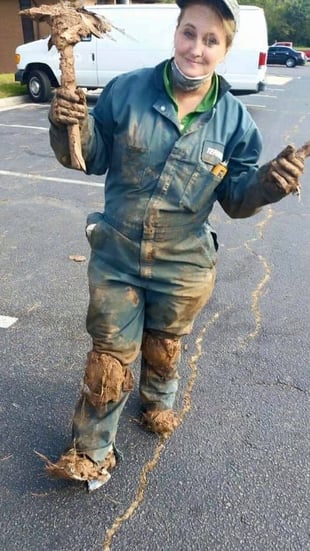
Rota relishes stepping on bugs, but snakes are another story. Some parts of the job still make her uneasy. Over the years, she’s faced skepticism from both customers and colleagues who doubted whether a woman belonged in pest control at all.
But necessity has a way of pushing people forward.
“When you’re a single mom and you’ve got to raise a family, you do what you have to do,” Rota said. “It doesn’t matter what it is, you just get out there and feed your family.”
That mindset traces back to advice from her mother.
“She always told me, ‘Nanette, it doesn’t matter what career you choose. Even if it’s being the garbage man, you be the best doggone garbage man there is.’”
Standing Out in a Male-Dominated Industry
Rota remembers one incident early in her career that still sticks with her.
After hearing a salesman might be skipping crawlspace inspections, she started paying closer attention — especially after he signed off on a recently flooded home. When she confronted him, the salesman joked that he’d stuck his head under the house. Rota wasn’t laughing.
Soon after the issue was flagged, an area manager stepped into the salesman’s office to investigate.
“The office was beside mine, so I could kind of hear what was going on,” Rota said. “They were laughing and joking and cutting up at my expense. They came out and [the area manager] goes, ‘Well, listen, he was just joking. He’s crawling the houses. You’re just overreacting.’”
Not long after, the same salesman signed another contract on a house where termite tubes were “as big as [Rota’s] arms,” and the homeowner’s water heater fell through the floor as a result of them.
Terminix let him go.
Moments like that weren’t isolated. Throughout her career, Rota says her judgment has often been questioned in ways her male counterparts rarely faced.
There was the new area manager who told her she’d be better off spending her time cleaning her house or taking care of her kids. There were the days she went door-to-door alone without the shield of a marked company vehicle — situations that could feel intimidating despite her uniform.
And there were moments when the pressure simply caught up with her.
“Sometimes I’d go in my office and shut the door and cry,” Rota said. “And [my boss] would say, ‘You need to toughen up. If I have to hold your hand, I don’t need you in that position.’”
Still, Rota says those experiences ultimately made her a stronger professional.
“I was so determined,” she said. “Like, okay you little crotchety dude, I’ll show you. And I did.”
Running a Pest Control Business
Rota’s transition into business ownership didn’t happen overnight. In fact, she credits much of that journey to the relationships she built through WIP&WC.
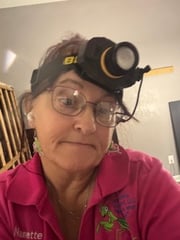
One connection in particular changed everything.
A fellow industry professional who quickly became both a mentor and close friend saw potential in Rota long before she saw it in herself.
“If you can sell $650,000 a year for Terminix, you can do this for yourself,” she remembers being told. At the time, Rota wasn’t convinced.
“I loved where I worked,” she said. “I didn’t want to leave.”
But the idea stuck. And over time, it grew louder, reinforced by a network of women in the industry who shared advice, asked questions, and supported one another.
“That was the camaraderie of the group,” Rota said. “We bounced things off each other.”
A diagnosis of autoimmune condition Guillain-Barré syndrome, which left her temporarily relying on a cane, forced Rota to reassess the pace and pressure of her career. Even after returning to work, the demands of a high-level role began to take a toll.
“At some point, you realize something has to change,” she said.
So she and her husband made a decision. They moved to the South Carolina coast, settling near Myrtle Beach — close to family, and closer to the kind of life they wanted to build.
Even then, jumping into business ownership felt daunting.
“When you’re making over $100,000 a year, and you’re about to go to zero, that’s scary,” Rota said.
With encouragement and a lot of faith, she decided to go for it.
Starting from scratch meant exactly that. Rota emptied her savings to secure a home that could accommodate her family’s needs and launched her business with just $100 in the bank.
Then came a turning point. At a WIP&WC conference, Rota — newly licensed and not yet fully operational — was awarded a small business grant.
The prize: $2,000 and enough product to sustain her for months.
“I was listening,” she said.
The business began to grow, slowly at first, as she balanced caregiving responsibilities at home, then rapidly. Within a year, she had tripled her business.
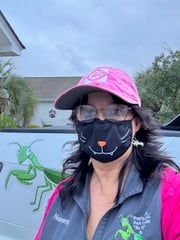
Rota built her company the same way she built her career: Organically, through relationships, referrals, and a willingness to do whatever it took to succeed. Even the name “Praying Nantis” reflects her own name, her faith, and a leap she wasn’t entirely sure she was ready to take.
Finding Community in the Industry
Being a woman in pest control can feel isolating.
“Honestly, I thought I was the only female in the industry,” Rota said. Turns out, she wasn’t.
For a while, Rota was feeling burnt out. She had started mentoring another saleswoman at her company, but when that colleague moved away, she found herself without that sense of connection again. Then, one day, she came across WIP&WC CEO Bobbie Terry in a magazine and reached out.
Terry responded, encouraging her to attend the group’s 2021 conference.
“I was geeked, girl,” Rota said. “I was so excited.”
At the time, the conference was entirely women, which is a rarity in an industry where men make up the overwhelming majority of the workforce. For Rota, it was the first time she realized how many others shared her experience.
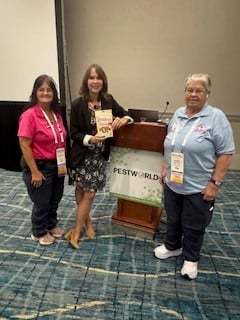
Today, the conference has evolved, expanding to include wildlife professionals and select co-ed sessions. But its core mission remains the same: Creating space for conversations that don’t always happen elsewhere.
“We still need a safe environment,” Rota said. “There are things we talk about that people don’t always think about.”
Those conversations include challenges unique to women in the field, something she once pointed out directly to a male critic.
“I'm not real shy,” Rota said. “I asked him, what size bra do you wear? No bra? Exactly. And do you ever have to worry about being pregnant and spraying and treating homes? No?”
Her point was clear.
The group also stands apart in another way. Most attendees aren’t just technicians or salespeople, they’re stakeholders.
“About 90% of the women in that room are business owners,” Rota said. “You’re talking to the people who can actually make decisions.”
For Rota, that sense of community and shared experience made all the difference.
Terry would become the mentor and close friend to eventually convince Rota to branch out on her own. And, after the former COO of WIP&WC stepped down, Rota would be invited to take her place.
Encouraging the Next Generation
Going door-to-door isn’t Rota’s only favorite part of the job anymore. These days, she finds just as much fulfillment in mentoring other women entering the pest control industry — especially those considering starting businesses of their own.
“As I’ve gotten older and I’m running my own business, mentoring younger women is quickly becoming my favorite part,” Rota said.
For many newcomers, she says, the excitement is there. So is the uncertainty.
“They’re fired up, and they see the potential,” she said. “But it’s scary.”
That’s where Rota steps in. Success in pest control, she emphasizes, takes more than technical skill.
“It’s more than just killing bugs,” she said. “If you can’t sell, you’re going to struggle.”
From pricing and customer relationships to working with vendors and testing products, Rota shares the lessons she’s learned over decades in the industry (often the hard way). For small business owners especially, she notes, every decision matters, and “every dollar counts.”
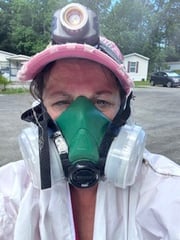
But beyond business advice, Rota hopes to show others the broader impact of the work.
“I think people don’t realize how much impact we have on our communities,” she said. “We protect the health of our communities.”
That impact extends beyond paying customers. Through partnerships with hospice organizations, Rota provides pro bono services for families dealing with pest issues during end-of-life care, ensuring they can focus on time with loved ones, not the stress of an infestation.
For Rota, it’s a reminder of what the industry can be. And for the next generation of women entering the field, it’s a path she’s eager to help them navigate.
